
Execution safety and auditability without rewriting your stack.
The Three Seals

No action should happen twice by accident.
Axnith enforces replay-safe behavior under retries, partial failures, and uncertain delivery conditions.

Seal 01
Idempotency Gatekeeper
Proof, not generic logs.
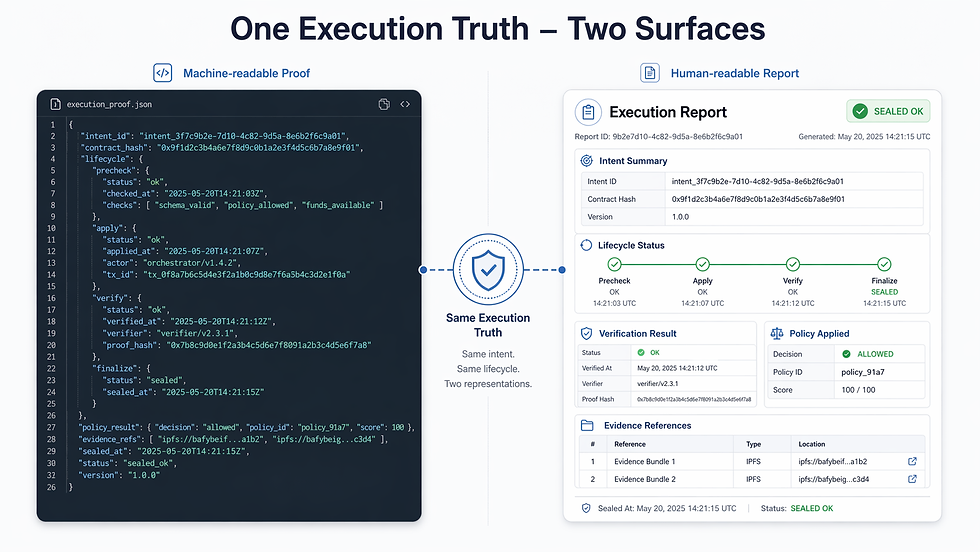
Axnith seals identity, policy result, reason codes, and evidence references into audit-grade proof surfaces designed for governance, review, and accountability.

Seal 02
Sealed Proof
Unsafe actions are blocked or held before they spread harm.
Axnith contains risk through policy, thresholds, and SAFE_HOLD semantics while preserving operational continuity where possible.

Seal 03
Risk Guard
The Deterministic Lifecycle

The Seals define the promise.
The Deterministic Lifecycle shows how Axnith keeps it.
PRECHECK → Validate policy, bounds, readiness, and execution discipline before side effects begin.
APPLY → Perform the intended change through the relevant
execution surface.
VERIFY → Confirm what actually happened in the real system.When reality cannot
yet be verified, Axnith models uncertainty honestly instead of pretending certainty.
FINALIZE → Seal the outcome into proof: intent identity, lifecycle result, reason codes, and evidence references.
Why this matters
Organizations increasingly rely on analytics, agents, and automated decision support to improve speed and efficiency. Yet the largest operational risk often appears after the recommendation is made — at the point where an intent becomes an executed system action.
This is where duplicates, retries, partial failures, policy drift, and unverifiable outcomes create material exposure.
Axnith is designed for that execution boundary.
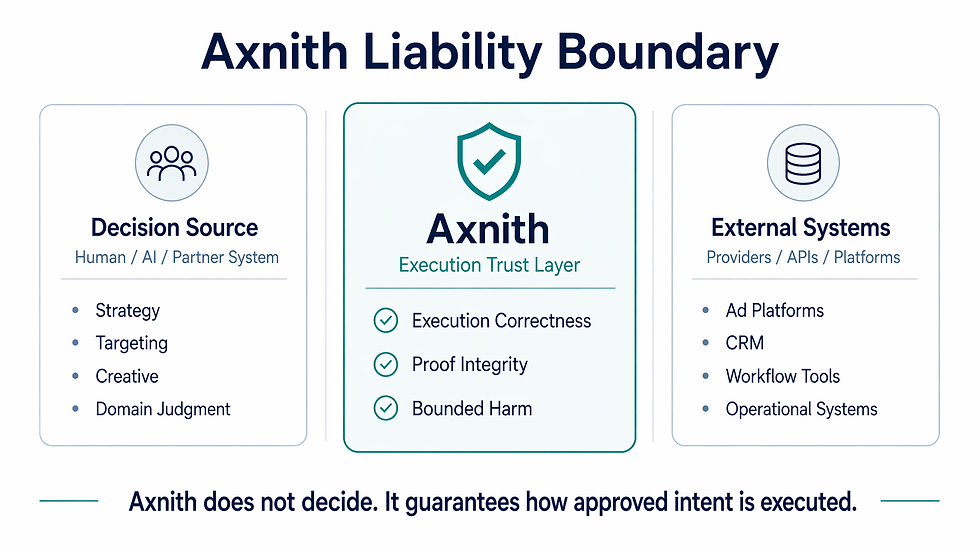
Axnith does not replace decision systems, workflow tools, identity providers, or operational platforms. It provides a deterministic execution trust layer that governs how approved intent is executed, verified, and sealed into proof.
Axnith helps organizations:
-
reduce execution risk in high-stakes automated workflows
-
enforce policy before side effects occur
-
model uncertainty honestly instead of masking it
-
contain systemic risk through bounded harm semantics
-
create exportable proof surfaces for operators, finance, legal, audit, and governance teams
Why this matters to enterprises
Enterprise automation does not fail only because of bad decisions. It also fails because execution is difficult to trust.
When a high-risk action touches a live system, leadership needs confidence that:
-
it was executed under policy
-
it can be verified against reality
-
uncertainty is visible, not hidden
-
material risk can be contained
-
the result can be reviewed after the fact
Axnith is built to provide that confidence.

Phase 1
First
Wedge
Revenue operations
already have analytics, AI recommendations, and operational triggers.
But the last mile — where an intent becomes a live budget change, campaign pause, workflow update, or message send — is still full of retries, race conditions, partial failures, policy drift, and silent leakage.
Axnith enters exactly there.

Phase 2
Adiacent Commercial Families
Expanding without rewriting the core
After the first wedge,
Axnith expands into commercially adjacent surfaces where the same execution trust problem appears in different forms.
-
Omnichannel
-
CRM
-
Pricing
-
CommerceOps
-
FinOps
-
ProcurementOps / SourcingOps

Phase 3
Later-wave but real High-Stakes families
These are not first wedges.
But they are real Axnith surfaces because they share the same core problem: high-risk actions taken under uncertainty.
-
Identity / Access Execution Governance
-
MedOps
-
LogOps
-
PayOps / TradeOps

Phase 4
Strategic Reserves
Long-horizon, high-consequence surfaces
Some domains fit Axnith’s genetics but are not part of the active roadmap.
These are strategic reserves, not near-term promises.
-
Critical Infrastructure / EnergyOps
-
Defense-Adjacent High-Stakes Governance
Axnith First Wedge
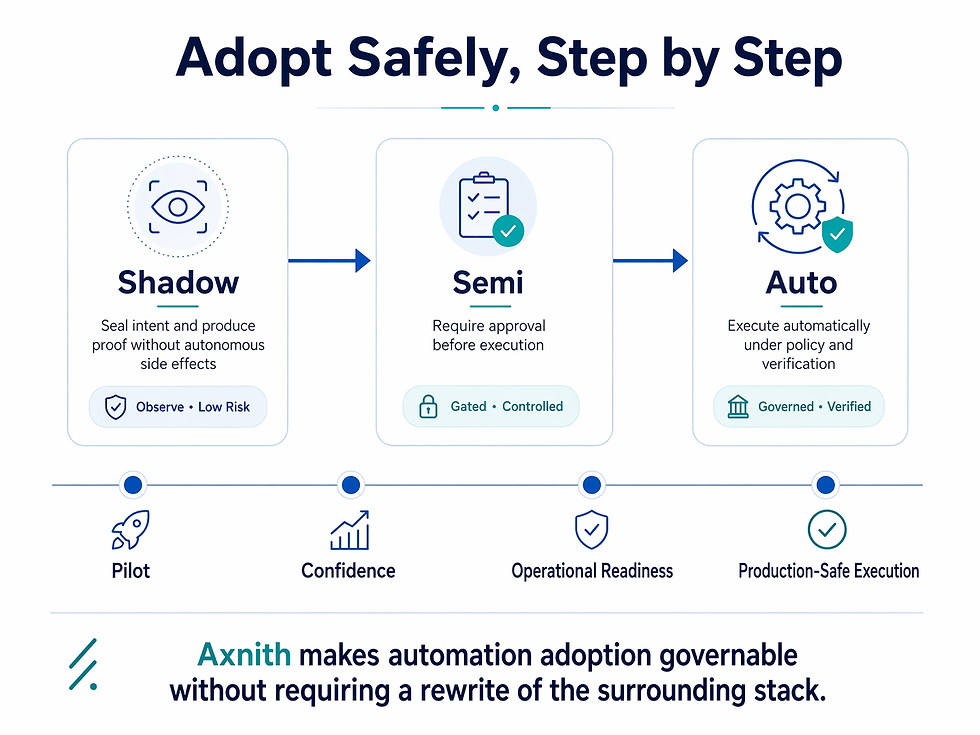
We start with high-risk execution surfaces in revenue operations, beginning with Ads and adjacent operational flows.
The same thin kernel can later extend across other high-stakes domains without rewriting the core.